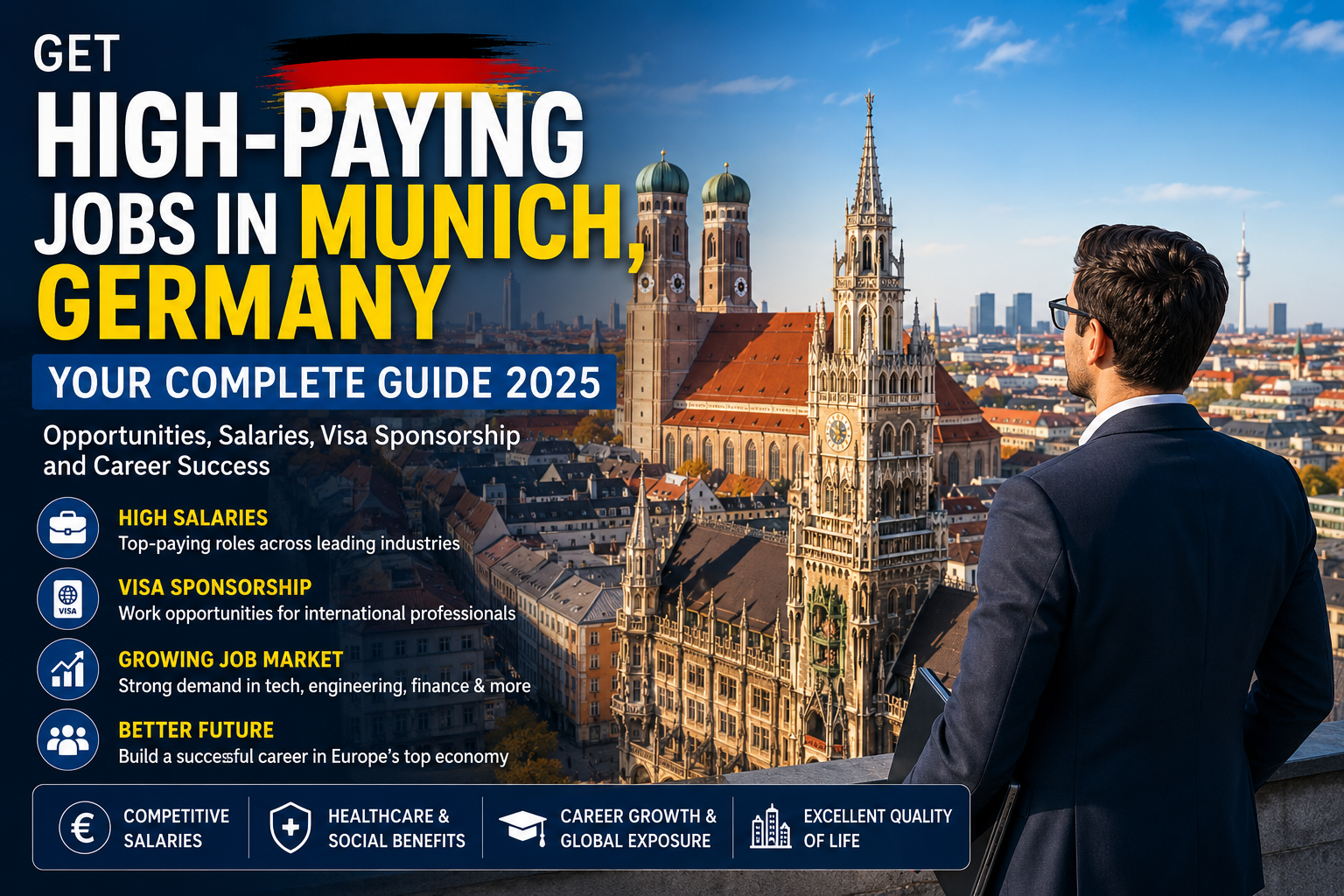
Munich, the capital of Bavaria, has steadily evolved into one of Europe’s most prosperous economic centers and a leading destination for professionals seeking high-paying career opportunities. Widely recognized for its strong economy, innovation culture, and exceptional quality of life, the city attracts thousands of skilled workers every year—from software engineers and financial analysts to healthcare specialists and advanced manufacturing experts.
Unlike many European cities that rely heavily on a single economic sector, Munich operates through a highly diversified economic ecosystem. Global corporations, research institutions, technology startups, and industrial giants collectively contribute to a business environment capable of generating some of the highest salaries in Germany. For professionals seeking long-term career security, international exposure, and strong earning potential, Munich offers opportunities that are difficult to match elsewhere.
Munich’s Position as Germany’s Economic Powerhouse
Munich consistently ranks among Germany’s strongest regional economies and contributes significantly to national economic performance. The city benefits from a unique combination of industrial strength and modern innovation, allowing traditional sectors and emerging technologies to thrive side by side.
Several factors continue to support Munich’s economic dominance:
- Strong industrial and manufacturing base
- Growing technology and AI ecosystem
- Presence of globally recognized corporations
- Research-driven university partnerships
- Startup-friendly environment
- Stable labor market with low unemployment rates
This combination has created an employment ecosystem where highly skilled professionals enjoy both financial rewards and career stability.
Many global companies maintain large headquarters or major operations within Munich, including:
- BMW
- Siemens
- Allianz
- MAN
- Infineon Technologies
- Munich Re
These organizations continuously recruit specialists in engineering, software development, finance, cybersecurity, artificial intelligence, and business strategy.
Their presence not only strengthens the local economy but also creates extensive indirect employment opportunities through suppliers, consulting firms, research organizations, and technology partners.
A Thriving Technology and Innovation Ecosystem
Munich has developed a reputation as Germany’s answer to Silicon Valley. The city’s rapidly expanding startup community and digital economy have earned it the nickname:
“Isar Valley.”
The area has become a hub for entrepreneurs, software developers, investors, and emerging technology firms focused on innovation.
Major growth areas include:
Software Development
Companies continue expanding engineering teams specializing in:
- Cloud computing
- Backend systems
- Mobile applications
- Enterprise platforms
- AI software solutions
Senior developers and architects often secure annual compensation packages exceeding six figures.
Artificial Intelligence and Machine Learning
AI investment in Munich continues growing rapidly as organizations automate operations and adopt intelligent systems.
Professionals with expertise in:
- Machine learning
- Computer vision
- Natural language processing
- predictive analytics
- automation systems
are increasingly among the city’s highest-paid workers.
Cybersecurity
As digital infrastructure expands, organizations face greater security risks.
This has produced increasing demand for:
- Security engineers
- penetration testers
- cloud security specialists
- information security managers
Cybersecurity professionals now occupy some of Munich’s most financially rewarding technical roles.
Data Science and Analytics
Data-driven decision-making has become central to business operations.
Organizations seek professionals skilled in:
- Python
- SQL
- machine learning frameworks
- business intelligence tools
- predictive modeling
Companies across industries—including healthcare, finance, and automotive manufacturing—depend heavily on data experts.
Why International Professionals Choose Munich
Munich’s appeal extends beyond salary figures.
For many international professionals, the city provides an attractive combination of:
Strong Income Potential
Professionals in technology, finance, engineering, and healthcare frequently secure compensation packages significantly above Germany’s national average.
Additional benefits often include:
- performance bonuses
- pension contributions
- private healthcare support
- stock options
- relocation allowances
Excellent Quality of Life
Munich consistently ranks among Europe’s most livable cities.
The city offers:
- efficient transportation systems
- low crime rates
- exceptional healthcare services
- clean public spaces
- world-class infrastructure
This creates an environment where career growth can coexist with personal well-being.
International Business Environment
Unlike smaller German cities, Munich has developed a highly international business culture.
Many employers now operate with English as a working language—particularly within:
- technology firms
- startups
- multinational corporations
- finance organizations
- research institutions
This significantly lowers barriers for skilled foreign workers.
Growing Demand for Skilled Talent
Germany continues experiencing shortages across several highly specialized professions.
Munich, as a center of industrial and technological development, faces especially strong competition for talent.
Areas currently experiencing significant hiring demand include:
| Sector | High-Demand Roles |
|---|---|
| Information Technology | Software Engineers, Cloud Architects |
| Engineering | Robotics Engineers, Electrical Specialists |
| Healthcare | Medical Researchers, Clinical Experts |
| Finance | Risk Managers, Analysts |
| Renewable Energy | Sustainability Consultants |
The shortage of qualified specialists has encouraged employers to provide stronger compensation packages and improved relocation incentives.
Many organizations now actively support:
- visa sponsorship
- housing assistance
- language training
- relocation support
- family integration programs
These initiatives make Munich increasingly attractive for international candidates seeking long-term opportunities.
Research Institutions Continue Driving Growth
Another major advantage Munich possesses is its close integration between academia and industry.
Prestigious institutions continue producing highly skilled graduates and advanced research:
- Technical University of Munich (TUM)
- Ludwig Maximilian University (LMU)
- Max Planck research institutes
These organizations collaborate closely with private employers.
This relationship fuels:
- technology transfer
- startup creation
- innovation funding
- scientific advancement
As a result, Munich continuously replenishes its talent pipeline while maintaining global competitiveness.
Why Munich Continues Outperforming Other European Cities
Few cities successfully combine:
- strong salaries
- economic stability
- innovation leadership
- global business access
- high living standards
Munich has managed to achieve all five.
Professionals relocating here often discover that while competition can be intense, the rewards are equally substantial.
For highly skilled candidates seeking career advancement and long-term financial growth, Munich represents more than simply another European city—it functions as a gateway to some of the most rewarding professional opportunities available today.
Munich’s Economic Landscape and the Highest Paying Industries Today
Munich is not simply another large German city with employment opportunities. It is one of Europe’s most influential business ecosystems—a place where industrial strength, digital innovation, and global investment intersect. Its economy consistently ranks among the strongest in Germany and remains one of the primary reasons professionals relocate in search of high-paying jobs.
The city’s success comes from a rare balance. Traditional industries such as manufacturing and automotive engineering continue to flourish, while rapidly expanding sectors like artificial intelligence, renewable energy, and cloud computing create entirely new opportunities for skilled workers.
This diversified structure gives Munich a major advantage over cities that rely heavily on a single industry. Economic shifts affecting one sector rarely weaken the city as a whole because multiple high-performing industries continue driving growth simultaneously.
Munich’s Role in Germany’s Economy
Munich serves as the economic heart of southern Germany and contributes substantially to national output.
Several factors continue to strengthen Munich’s position:
- Strong manufacturing and industrial activity
- High concentration of global corporations
- International investment inflows
- Advanced research infrastructure
- Innovation partnerships between universities and private companies
- Continuous startup expansion
The city consistently records one of Germany’s lowest unemployment rates and maintains a stable labor market even during periods of economic uncertainty.
This stability creates a significant advantage for professionals seeking long-term career security.
Major Companies Fueling Munich’s High-Income Job Market
Munich hosts some of the world’s largest and most respected organizations.
These employers generate thousands of high-paying positions while creating ripple effects throughout the local economy.
Some of the most influential employers include:
BMW
Automotive engineering and mobility innovation remain central to Munich’s identity. BMW employs thousands of specialists across software, manufacturing, robotics, AI, and engineering disciplines.
Siemens
Siemens continues driving innovation in automation, industrial technology, energy systems, and smart infrastructure.
Allianz
One of the world’s largest insurance and financial services firms, Allianz recruits heavily in finance, data science, analytics, cybersecurity, and risk management.
Infineon Technologies
The growing semiconductor industry has increased demand for engineers and technology specialists.
Munich Re
Munich Re continues creating high-income opportunities in actuarial science, financial risk assessment, and insurance technology.
These corporations help maintain Munich’s reputation as one of Europe’s strongest employment markets.
Highest Paying Industries in Munich Today
While employment exists across nearly every sector, some industries consistently produce significantly higher salaries than others.
Understanding these sectors is essential for professionals aiming to maximize income potential.
Technology and Information Technology
Technology remains Munich’s largest generator of high-paying opportunities.
The city’s expanding digital economy continues creating strong demand for:
- software developers
- machine learning engineers
- cloud architects
- cybersecurity specialists
- DevOps engineers
- AI researchers
- technical project managers
Average annual salaries often range between:
| Position | Estimated Salary |
|---|---|
| Software Engineer | €70,000–€115,000 |
| Data Scientist | €75,000–€125,000 |
| Cloud Architect | €85,000–€130,000 |
| AI Specialist | €90,000–€140,000 |
Professionals with expertise in:
- Python
- Java
- cloud infrastructure
- machine learning frameworks
- cybersecurity systems
continue seeing strong hiring demand.
The rise of AI platforms and automation technologies suggests this demand will remain strong for years.
Engineering and Automotive Excellence
Engineering remains one of Munich’s most important economic pillars.
The city’s industrial sector has evolved far beyond traditional manufacturing and now incorporates:
- electric vehicle development
- robotics
- autonomous systems
- sustainable mobility
- industrial AI
Highly sought engineering disciplines include:
Mechanical Engineering
Professionals design systems used in manufacturing, transportation, and energy production.
Electrical Engineering
Demand continues growing in:
- embedded systems
- automation
- power electronics
- semiconductor technologies
Robotics and Automation
Companies increasingly seek engineers capable of integrating intelligent manufacturing systems.
Average compensation often reaches:
| Engineering Specialty | Salary Range |
|---|---|
| Mechanical Engineer | €65,000–€110,000 |
| Electrical Engineer | €70,000–€120,000 |
| Robotics Engineer | €75,000–€125,000 |
The transition toward electric mobility continues increasing opportunities throughout this sector.
Finance and Insurance Remain Extremely Lucrative
Munich is also one of Germany’s most important financial centers.
Professionals in banking, consulting, insurance, and investment management often secure highly competitive salaries.
High-demand finance positions include:
- investment analysts
- auditors
- corporate finance specialists
- risk managers
- strategy consultants
- compliance officers
Compensation packages frequently include:
- annual bonuses
- pension plans
- private healthcare support
- stock incentives
Estimated annual income:
| Finance Role | Salary Range |
|---|---|
| Financial Analyst | €70,000–€110,000 |
| Risk Manager | €80,000–€130,000 |
| Strategy Consultant | €85,000–€145,000 |
Professionals with expertise in:
- financial modeling
- compliance
- regulatory law
- data analysis
remain highly sought after.
Healthcare and Biotechnology Continue Expanding
Healthcare and life sciences have experienced enormous growth throughout Munich.
Research institutions, hospitals, and pharmaceutical organizations increasingly recruit specialists in:
- clinical research
- biotechnology
- bioinformatics
- healthcare analytics
- pharmaceutical science
The integration of AI into medicine has accelerated demand further.
Growing fields include:
- medical data science
- genetic analysis
- healthcare technology systems
Estimated salary ranges:
| Position | Annual Salary |
|---|---|
| Clinical Researcher | €60,000–€100,000 |
| Biotechnology Engineer | €70,000–€115,000 |
| Clinical Project Manager | €65,000–€110,000 |
The long-term outlook for healthcare professionals remains exceptionally strong.
Renewable Energy and Sustainability Careers
Germany’s green transformation continues creating entirely new employment opportunities.
Munich has become increasingly important in sustainability-focused sectors including:
- solar energy
- hydrogen technology
- carbon reduction initiatives
- smart infrastructure
- environmental consulting
Growing environmental investment has increased demand for:
- sustainability consultants
- energy engineers
- climate analysts
- environmental project managers
Many professionals now combine technical engineering skills with environmental expertise.
Why Munich’s Diverse Economy Creates Better Opportunities
One of Munich’s biggest strengths is diversification.
Many cities rely heavily on one sector:
- finance
- manufacturing
- tourism
- government employment
Munich spreads economic activity across multiple industries.
This creates:
- stronger employment stability
- better career mobility
- reduced economic risk
- more opportunities for specialization
Professionals can shift industries while remaining in the same city.
For example:
A software engineer might transition from automotive manufacturing into finance, healthcare technology, or AI startups without relocating.
This flexibility significantly strengthens long-term earning potential.
Munich’s economy continues rewarding professionals who combine technical expertise with adaptability. Those entering fast-growing sectors today position themselves for both immediate financial gain and long-term career security.
Opportunities for Expats, Salaries, Cost of Living, and How to Get High Paying Jobs in Munich, Germany Today
Opportunities for Expats and English-Speaking Professionals in Munich
Munich has transformed into one of the strongest destinations in Europe for skilled international workers seeking career advancement and financial growth. While Germany has long been known for industrial strength and engineering excellence, Munich has increasingly positioned itself as a global city where international talent plays a central role in economic expansion.
Today, thousands of foreign professionals relocate to Munich annually because of the city’s combination of strong salaries, business opportunities, international companies, and excellent living standards.
Unlike in previous decades, where speaking fluent German was often essential before employment, many sectors now actively recruit English-speaking professionals.
This shift has largely been driven by:
- International expansion of German corporations
- Rapid growth in technology and AI sectors
- Startup globalization
- Labor shortages in highly specialized industries
- Increased demand for global talent
As a result, Munich now competes with cities such as Amsterdam, Dublin, London, and Zurich for international professionals.
Why Munich Appeals to Global Professionals
International workers often choose Munich because it provides a combination of economic opportunity and lifestyle quality rarely found elsewhere.
Key advantages include:
Strong salaries
Professionals frequently earn significantly above European averages.
Stable employment conditions
Germany’s labor protections create strong job security.
World-class healthcare
Residents benefit from one of Europe’s strongest healthcare systems.
Public transportation efficiency
Daily commuting is convenient and reliable.
Global business presence
Multinational firms make career mobility easier.
Pathways to permanent residency
Immigration routes allow long-term settlement.
For many skilled professionals, Munich represents not merely a job destination but a location for building long-term financial and personal stability.
English-Speaking Jobs in Munich
One of the most common concerns among foreign workers is whether German fluency is mandatory.
The answer depends largely on industry.
Many sectors increasingly conduct operations in English, particularly those connected to international markets.
Examples include:
Technology and Software Development
Large technology firms and startups frequently use English as their operational language.
Common positions include:
- Software engineers
- Backend developers
- AI specialists
- Product managers
- Data scientists
- UX designers
- DevOps engineers
Estimated salaries:
€70,000–€120,000+
Finance and International Banking
Global financial organizations frequently hire professionals with international experience.
Roles include:
- Financial analysts
- Risk specialists
- Wealth managers
- Investment professionals
- Corporate finance advisors
Estimated salaries:
€75,000–€130,000+
Engineering
Engineering employers often require technical proficiency more than perfect German language skills.
High-demand areas include:
- Mechanical engineering
- Robotics
- Automation systems
- Electrical systems
- EV technology
Estimated salaries:
€65,000–€115,000+
Research and Academia
Munich’s universities and research institutions operate heavily in English.
International researchers commonly find opportunities in:
- Artificial intelligence
- Biotechnology
- Computer science
- Medical research
- Environmental sciences
Estimated salaries:
€60,000–€105,000+
Visa and Immigration Routes for Skilled Professionals
Germany has modernized immigration pathways significantly to attract global workers.
Several routes now provide relatively straightforward entry into Munich’s workforce.
EU Blue Card
The EU Blue Card remains one of the most popular options.
Requirements generally include:
- University qualification
- Employment offer
- Minimum salary threshold
- Recognized credentials
Major advantages:
- Fast-track permanent residency
- Family reunification
- Long-term work flexibility
- Access to broader EU mobility opportunities
For many professionals in:
- IT
- Healthcare
- Engineering
- Finance
this route offers the most practical path.
Job Seeker Visa
Applicants can enter Germany temporarily while searching for work.
Benefits include:
- Local networking opportunities
- Face-to-face interviews
- Faster hiring processes
After receiving an offer, candidates often transition into standard work permits or Blue Cards.
Skilled Worker Immigration Pathway
Germany recently expanded skilled worker reforms.
These changes aim to:
- Reduce qualification barriers
- Accelerate processing times
- Address labor shortages
- Increase recruitment of foreign specialists
Priority sectors include:
- Digital technology
- Healthcare
- Green energy
- Engineering
- Artificial intelligence
Integration and Building a Long-Term Future
While English may initially open doors, long-term advancement usually improves significantly through German language development.
Learning German often creates advantages including:
Better Promotion Opportunities
Leadership positions often require stronger communication abilities.
Improved Salary Negotiation Power
Employees with bilingual capability frequently command stronger compensation.
Wider Networking Reach
Professional relationships become easier to build.
Stronger Social Integration
Daily life becomes substantially smoother.
Many employers assist through:
- Sponsored language classes
- Cultural workshops
- Integration programs
- relocation support
These initiatives help international professionals settle faster.
Salary Expectations and Cost of Living in Munich
Munich consistently ranks among Germany’s highest-paying cities.
However, premium salaries come alongside premium expenses.
Understanding both sides is critical.
Many newcomers focus only on salary figures and overlook living costs.
Strong financial planning is therefore essential.
Average Salary Levels in Munich
Average annual salaries often exceed national averages.
Examples:
| Profession | Salary Range |
|---|---|
| Software Engineer | €70,000–€110,000 |
| Data Scientist | €75,000–€120,000 |
| Mechanical Engineer | €65,000–€100,000 |
| Investment Analyst | €75,000–€130,000 |
| Legal Consultant | €80,000–€140,000 |
| Project Manager | €70,000–€115,000 |
Senior professionals frequently exceed:
€150,000+
Compensation may also include:
- Annual bonuses
- Private health insurance
- Stock options
- Pension contributions
- Relocation packages
- transportation support
These additions substantially increase total earnings.
Housing Costs in Munich
Housing is typically the largest expense.
Approximate monthly costs:
One-bedroom apartment in city center
€1,400–€2,000
Outside city center
€1,000–€1,300
Family apartments
€2,200–€2,800+
Demand often exceeds supply.
Many professionals therefore negotiate:
- Housing assistance
- Temporary accommodation
- relocation support
during hiring discussions.
Additional Living Costs
Utilities:
€250–€350 monthly
Transportation:
€60–€85 monthly
Groceries:
€300–€400
Dining and leisure:
€250–€400
Despite these expenses, strong salaries often maintain excellent purchasing power.
How to Get High Paying Jobs in Munich, Germany Today
Securing a high-income role requires more than qualifications alone.
Munich’s market rewards preparation, strategic networking, and professional positioning.
Many candidates fail not because they lack skills but because they overlook recruitment dynamics.
Step 1: Use Specialized Job Platforms
Popular platforms include:
- StepStone
- Indeed Germany
- Glassdoor
Many employers also advertise directly on company websites.
Step 2: Build a German-Style CV
Employers typically prefer:
- chronological format
- measurable achievements
- complete work history
- technical skills
- certifications
- language proficiency
Tailored applications dramatically outperform generic submissions.
Step 3: Prioritize Networking
Many opportunities never reach public job boards.
Networking methods:
- Industry events
- Conferences
- Startup communities
- Professional groups
- Alumni networks
Strong relationships often produce faster hiring outcomes.
Step 4: Gain In-Demand Certifications
Highly valued certifications include:
- PMP
- AWS
- CFA
- Scrum Master
- Google Analytics
- Machine Learning credentials
Upskilling remains one of the fastest routes toward salary growth.
Step 5: Prepare Intensively for Interviews
German interviews often emphasize:
- technical competence
- reliability
- professionalism
- structure
- cultural fit
Preparation should include:
- company research
- achievement examples
- problem-solving scenarios
- communication practice
Punctuality matters greatly.
Arriving late can seriously damage first impressions.
Interview Success, Salary Negotiation, Workplace Culture, and Building Long-Term Career Growth in Munich
After creating a strong CV, building connections, and finding opportunities, the next challenge is converting applications into actual job offers. Munich’s labor market rewards professionals who understand not only technical requirements but also business culture, communication standards, and long-term professional strategy.
Many qualified applicants lose opportunities because they underestimate how structured and detail-oriented the German hiring system can be. Employers often evaluate candidates beyond skills alone. Reliability, organization, professionalism, and cultural fit frequently influence final hiring decisions.
Learning how employers think can significantly improve your chances of landing high-paying jobs in Munich.
Understanding Munich’s Recruitment Process
Recruitment procedures in Munich can differ from those in many other countries.
The process often involves multiple stages, particularly for high-paying positions.
A typical hiring structure may include:
Stage 1: Initial Application Review
Human resource departments evaluate:
- Work experience
- Educational background
- Certifications
- Language skills
- Industry expertise
- Resume structure
Applications that closely match requirements move to the next stage.
Stage 2: Screening Interview
This may occur through:
- Telephone interviews
- Video calls
- Virtual meetings
Recruiters commonly discuss:
- Career background
- Motivation
- relocation plans
- salary expectations
- visa status
International candidates should prepare concise explanations regarding their move to Germany.
Stage 3: Technical Assessment
For technical and specialist positions, assessments often include:
Technology
- coding exercises
- system design problems
- technical case studies
Finance
- financial modeling
- market analysis scenarios
- valuation exercises
Engineering
- practical design tasks
- calculations
- technical presentations
Consulting
- business cases
- strategic problem-solving scenarios
Employers frequently assess thought process as much as final answers.
Stage 4: Final Management Interviews
Senior managers typically focus on:
- leadership capability
- workplace compatibility
- long-term ambitions
- communication style
- adaptability
Candidates should demonstrate confidence while remaining professional and realistic.
Mastering Interviews for High Paying Jobs in Munich
Interviews in Germany often differ from hiring practices elsewhere.
Many employers value direct communication and substance over exaggeration.
Preparation therefore becomes extremely important.
Research the Company Thoroughly
Before attending interviews, understand:
- company products
- business model
- leadership structure
- market competitors
- recent developments
- future goals
Recruiters often expect applicants to understand company operations.
Questions like:
“Why do you want to work here?”
require detailed answers.
Weak generic responses can reduce credibility.
Prepare Achievement Stories
Employers frequently ask questions such as:
“Describe a challenge you solved.”
“Tell us about a difficult project.”
“Explain a leadership situation.”
Strong answers often use structured storytelling:
Situation
Task
Action
Result
This approach provides measurable evidence.
Example:
Instead of saying:
“I improved team performance.”
Say:
“I implemented a process automation system that reduced reporting time by 35%.”
Specific outcomes create stronger impressions.
Demonstrate Reliability
German employers often prioritize consistency and trustworthiness.
They appreciate candidates who show:
- preparation
- punctuality
- organization
- accountability
- professionalism
These qualities sometimes carry equal importance to technical expertise.
Common Interview Topics
Expect discussions around:
Teamwork
How you collaborate with colleagues.
Leadership
Examples of guiding people or projects.
Conflict Resolution
Handling workplace disagreements.
Adaptability
Responding to changing conditions.
Long-Term Career Plans
Why Munich fits into your future goals.
Employers prefer candidates who intend to contribute long-term rather than leave after a short period.
Salary Negotiation in Munich
Receiving an offer creates a major opportunity.
Many international professionals hesitate during salary negotiations because they fear losing the role.
However, negotiation is expected in Germany—particularly for skilled positions.
The key is presenting realistic, research-based expectations.
Understand Market Salary Levels
Research average compensation using:
- Glassdoor
- LinkedIn Salary
- StepStone reports
- recruiter feedback
- industry publications
Negotiating without market knowledge creates disadvantages.
Sample Salary Benchmarks
| Position | Salary Range |
|---|---|
| Software Engineer | €70,000–€115,000 |
| Data Scientist | €80,000–€125,000 |
| Cloud Architect | €90,000–€130,000 |
| Financial Analyst | €75,000–€130,000 |
| Legal Advisor | €85,000–€140,000 |
Compensation often depends on:
- experience
- technical specialization
- industry
- company size
- negotiation strength
Looking Beyond Salary
High-paying jobs frequently include extensive benefit packages.
Professionals should evaluate total compensation.
Important benefits include:
Performance Bonuses
Often:
10–20% of annual income
or higher.
Pension Contributions
Many employers contribute additional retirement funding.
Insurance Benefits
Examples include:
- private health insurance
- life insurance
- disability coverage
Professional Development Support
Many organizations sponsor:
- certifications
- executive education
- training programs
- conference attendance
Relocation Assistance
International professionals frequently receive:
- visa support
- temporary accommodation
- travel reimbursement
- family relocation help
Reviewing Employment Contracts Carefully
Before signing an agreement, review every section carefully.
Pay attention to:
Notice Periods
German contracts often include:
1–6 month notice requirements.
Probation Terms
Many employers apply:
6-month probation periods.
Overtime Policies
Clarify:
- compensation methods
- flexible hours
- time-off arrangements
Bonus Structures
Understand:
- payment conditions
- performance targets
- eligibility requirements
Non-Compete Clauses
Some employers restrict movement to competitors.
Review these carefully.
Professional legal review may sometimes be worthwhile.
Understanding German Workplace Culture
Adapting to workplace culture significantly influences career growth.
Technical ability alone rarely guarantees success.
Munich employers frequently emphasize cultural fit.
Punctuality Matters
Time management receives serious attention.
Arriving:
- late to meetings
- missing deadlines
- delaying responses
can negatively affect professional reputation.
Even minor delays sometimes create poor impressions.
Direct Communication
German business communication is often straightforward.
Feedback may appear more direct than in other countries.
This usually reflects efficiency rather than hostility.
Employees are expected to:
- communicate clearly
- discuss problems honestly
- provide factual information
Respect for Structure
Organizations frequently value:
- planning
- documentation
- process consistency
Spontaneous changes often require substantial justification.
Work-Life Balance
Interestingly, despite high productivity expectations, Germany strongly supports personal wellbeing.
Many employees enjoy:
25–30 vacation days annually
35–40 hour workweeks
family protections
hybrid work arrangements
This creates sustainable long-term careers.
Building a Reputation for Long-Term Growth
Landing a high-paying role is only the beginning.
Munich strongly rewards professionals who continually improve.
Long-term career advancement often depends upon:
Continued education
certifications
networking
leadership development
adaptability
Professionals who stop learning often lose competitiveness.
Long-Term Growth Strategies
Expand Technical Expertise
Develop emerging skills:
- AI
- automation
- cloud computing
- cybersecurity
- sustainability systems
Strengthen Leadership Skills
High-income positions increasingly require:
- decision-making
- communication
- strategic thinking
Build Industry Visibility
Ways include:
- speaking at events
- publishing insights
- contributing to industry communities
- participating in conferences
Visibility frequently attracts recruiters.
Munich rewards professionals who combine expertise with consistency, professionalism, and strategic planning.
Future Job Trends, Emerging Industries, and Munich’s Employment Outlook Beyond 2025
Munich’s Next Chapter: Where the Future of Work Is Heading
Munich has already established itself as one of Europe’s most influential economic centers, but the city’s strongest years may still be ahead. As global industries rapidly evolve through technological innovation, environmental transformation, and changing workforce models, Munich continues adapting faster than many competing cities.
For professionals planning a long-term career move, understanding where opportunities are heading is just as important as understanding where they currently exist.
The industries dominating hiring today may look very different over the next decade.
Professionals who position themselves early often gain the greatest rewards.
Munich’s future labor market is expected to be driven by:
- Artificial intelligence
- Renewable energy
- Robotics
- Advanced manufacturing
- Biotechnology
- Smart infrastructure
- Digital finance
- Cybersecurity
- Automation systems
These industries are expected to generate some of Germany’s highest-paying employment opportunities.
Artificial Intelligence and Machine Learning Expansion
Artificial intelligence has moved beyond experimentation.
Businesses across industries now rely heavily on AI systems.
Munich has become one of Germany’s strongest AI centers due to collaboration between:
- universities
- research institutes
- technology companies
- startup ecosystems
- multinational corporations
This collaboration is rapidly reshaping employment needs.
AI Roles Expected to Grow Rapidly
Examples include:
| Position | Estimated Salary |
|---|---|
| AI Engineer | €90,000–€140,000 |
| Machine Learning Specialist | €85,000–€130,000 |
| NLP Engineer | €90,000–€145,000 |
| Data Scientist | €80,000–€125,000 |
| AI Product Manager | €100,000–€150,000 |
Demand continues rising because organizations increasingly automate:
- customer operations
- predictive analysis
- manufacturing systems
- healthcare diagnostics
- financial decision-making
Professionals combining programming expertise with business understanding will likely enjoy major advantages.
Skills That Will Become More Valuable
Future employers increasingly prioritize:
Python development
Machine learning frameworks
Data modeling
Cloud platforms
AI ethics understanding
Automation systems
Professionals investing early in these capabilities may benefit significantly.
Smart Manufacturing and Industry 4.0
Germany remains a manufacturing powerhouse.
However, factories increasingly rely on:
- robotics
- automation
- connected systems
- intelligent machines
This transition—commonly called Industry 4.0—is reshaping engineering careers.
Munich sits at the center of this transformation.
High-Demand Manufacturing Careers
Expected growth areas include:
| Role | Salary Range |
|---|---|
| Robotics Engineer | €75,000–€125,000 |
| Automation Architect | €80,000–€130,000 |
| Systems Integration Engineer | €75,000–€120,000 |
| Smart Factory Consultant | €80,000–€135,000 |
Companies increasingly seek professionals who understand:
- industrial software
- automation systems
- AI integration
- production optimization
The line between engineering and technology continues to blur.
Electric Mobility and Transportation Innovation
Munich’s automotive industry is experiencing major change.
Traditional combustion technologies gradually shift toward:
- electric vehicles
- autonomous systems
- smart mobility platforms
- sustainable transportation infrastructure
Major employers continue investing billions in:
battery technology
vehicle software
mobility ecosystems
advanced transportation research
This evolution creates entirely new career categories.
Emerging Automotive Careers
Examples include:
Battery Systems Engineer
EV Software Developer
Autonomous Driving Specialist
Vehicle AI Architect
Sustainable Mobility Consultant
Estimated salary ranges frequently exceed:
€70,000–€130,000+
Renewable Energy and Sustainability
Environmental transformation is becoming one of Germany’s strongest economic priorities.
Munich increasingly invests in:
- solar technologies
- hydrogen systems
- wind energy
- sustainable infrastructure
- green mobility
Germany’s long-term climate strategy ensures strong demand for sustainability professionals.
Future Green Economy Roles
Examples include:
| Position | Salary Range |
|---|---|
| Renewable Energy Engineer | €70,000–€115,000 |
| ESG Analyst | €75,000–€120,000 |
| Sustainability Consultant | €65,000–€110,000 |
| Green Infrastructure Manager | €80,000–€125,000 |
Organizations increasingly integrate environmental priorities into:
investment decisions
construction projects
corporate strategies
financial reporting
As a result, sustainability expertise is becoming highly valuable.
Growth of Biotechnology and Medical Innovation
Munich also continues expanding within life sciences.
Increasing global demand for:
- precision medicine
- biotechnology
- bioinformatics
- medical AI
- healthcare innovation
creates major employment opportunities.
The city’s strong university partnerships accelerate research activity.
Fast-Growing Healthcare and Biotech Careers
Examples include:
Clinical Data Specialist
Genetic Research Scientist
Bioinformatics Expert
Biomedical Engineer
Medical Technology Analyst
Estimated salaries:
€65,000–€120,000+
The combination of medicine and technology creates particularly strong long-term potential.
Digital Finance and Financial Technology Expansion
Finance itself is changing rapidly.
Traditional banking increasingly overlaps with:
- automation
- AI systems
- blockchain technologies
- digital payments
- cybersecurity
Munich’s finance ecosystem increasingly supports financial innovation.
Emerging Financial Careers
Examples include:
| Position | Salary |
|---|---|
| FinTech Product Specialist | €85,000–€130,000 |
| Blockchain Analyst | €80,000–€125,000 |
| Risk Technology Consultant | €90,000–€140,000 |
| Digital Banking Strategist | €90,000–€145,000 |
Professionals who understand both technology and finance may become particularly valuable.
Remote Work and Global Talent Expansion
One of the biggest shifts affecting Munich involves remote employment.
Companies increasingly recruit internationally.
Many organizations now operate with:
- hybrid work models
- international teams
- distributed collaboration systems
This creates opportunities for professionals worldwide.
Benefits include:
broader talent access
flexible working arrangements
global career mobility
increased employer competition
Companies increasingly compete to attract highly skilled specialists.
Government Initiatives Supporting Growth
Germany continues introducing policies designed to strengthen future industries.
Important initiatives include:
Skilled Immigration Expansion
Simplifying pathways for international workers.
STEM Investment Programs
Increasing support for:
- science
- engineering
- technology education
Green Infrastructure Funding
Encouraging sustainability-focused industries.
Digital Germany Strategy
Accelerating modernization across sectors.
These initiatives create long-term labor demand.
How Professionals Can Stay Competitive
Rapid technological change creates both opportunity and risk.
Professionals should prioritize continuous development.
Strategies include:
learning emerging technologies
obtaining certifications
improving digital literacy
strengthening leadership capability
expanding international networks
Workers who adapt consistently often maintain stronger long-term income growth.
Looking Toward the Future
Munich’s economic outlook remains exceptionally strong.
Several factors support continued growth:
- global investment
- innovation leadership
- research excellence
- government support
- skilled immigration programs
This creates a powerful environment for long-term career development.
Professionals who enter growing sectors early may position themselves for extraordinary financial rewards.
Munich is no longer simply a German business center.
It increasingly serves as one of Europe’s primary engines of technological and economic transformation.
Final Thoughts, Career Strategy, and Long-Term Success in Munich
Munich: Germany’s Economic Giant for Ambitious Professionals
Munich has firmly established itself as one of the most attractive destinations in Europe for professionals seeking exceptional salaries, global exposure, and long-term career security. While many cities offer employment opportunities, very few combine economic strength, innovation leadership, infrastructure quality, and international accessibility at Munich’s level.
Over the years, Munich has transformed from a traditional industrial center into a global ecosystem where technology, finance, engineering, healthcare, sustainability, and research converge.
For skilled workers pursuing high-paying jobs in Germany, the city represents more than a location for employment—it provides a complete environment for building a prosperous future.
Professionals who relocate to Munich frequently discover opportunities extending beyond salary growth alone. The city creates pathways toward:
- International career advancement
- Financial stability
- Long-term wealth creation
- Professional recognition
- Family security
- Permanent settlement opportunities
This combination explains why Munich consistently attracts global talent.
Key Industries Driving Munich’s High-Paying Job Market
Throughout this guide, several sectors have repeatedly emerged as dominant contributors to Munich’s economy.
These industries continue creating strong employment opportunities because they combine innovation with long-term sustainability.
Major sectors include:
Technology and Software Development
Roles involving:
- Artificial intelligence
- Cloud systems
- Data science
- Software engineering
- Machine learning
- Cybersecurity
remain among the highest-paying and fastest-growing opportunities available.
Many organizations increasingly rely on digital infrastructure and automation, creating substantial demand for technical specialists.
Average salary potential:
€70,000–€130,000+
Engineering and Manufacturing
Munich’s industrial identity remains powerful.
Fields including:
- Robotics
- Mechanical engineering
- Electric mobility
- Automation systems
- Sustainable manufacturing
continue generating significant demand.
Germany’s transition toward smarter manufacturing ensures engineering professionals remain highly valuable.
Average salary potential:
€65,000–€120,000+
Finance and Business Consulting
Munich’s financial institutions and consulting firms continue attracting global professionals.
High-income areas include:
- Investment analysis
- Risk management
- Corporate finance
- FinTech
- Strategy consulting
Strong compensation packages and advancement opportunities make these sectors highly attractive.
Average salary potential:
€75,000–€140,000+
Healthcare and Biotechnology
The combination of healthcare innovation and research expansion continues strengthening Munich’s medical economy.
High-growth specialties include:
- Clinical research
- Bioinformatics
- Medical technology
- Biotechnology engineering
Average salary potential:
€65,000–€115,000+
Renewable Energy and Sustainability
The green economy is rapidly becoming one of Munich’s strongest future industries.
Growing sectors include:
- Environmental consulting
- Renewable engineering
- ESG management
- Green infrastructure planning
Professionals with sustainability expertise increasingly command premium salaries.
Average salary potential:
€70,000–€120,000+
Why International Professionals Continue Choosing Munich
Munich’s attractiveness extends beyond income.
Many international professionals evaluate several additional factors before relocating:
Immigration pathways
Germany increasingly supports skilled migration.
Programs such as:
- EU Blue Card
- Skilled Worker pathways
- Job Seeker visas
simplify entry processes.
Strong labor protections
German employment law provides:
- job security
- paid leave
- social protections
- retirement contributions
Global workplaces
International firms increasingly operate using English.
This creates opportunities even for professionals still learning German.
Family-friendly environment
Munich provides:
- quality healthcare
- international schools
- safe communities
- efficient public transportation
For families relocating internationally, these advantages significantly improve quality of life.
Long-Term Career Strategy for Professionals
Securing a high-paying role is an important milestone.
However, long-term career success requires continued effort.
Munich rewards professionals who actively invest in personal development.
Several strategies can strengthen career growth:
Continue Learning
Technology evolves rapidly.
Professionals should consistently upgrade knowledge in areas such as:
- AI
- cloud infrastructure
- leadership
- automation
- digital systems
Continuous learning often separates top earners from average performers.
Build Strong Networks
Relationships frequently create opportunities unavailable through job boards.
Useful networking activities include:
- conferences
- professional associations
- LinkedIn engagement
- local business events
- startup communities
Professional visibility frequently accelerates growth.
Develop Leadership Skills
As careers advance, technical expertise alone becomes insufficient.
Organizations increasingly reward:
- communication
- decision-making
- management capability
- strategic thinking
Leadership often determines movement toward executive compensation levels.
Understand Cultural Expectations
Long-term success in Munich also requires adapting to German business culture.
Important values include:
- punctuality
- precision
- reliability
- professionalism
- accountability
Professionals who embrace these expectations often integrate faster.
Financial Planning Matters
High salaries become significantly more valuable when paired with effective financial management.
Professionals should prioritize:
- retirement planning
- pension contributions
- investment strategies
- tax optimization
- emergency savings
Long-term wealth creation depends on strategy rather than income alone.
The Future Outlook Remains Strong
Munich continues benefiting from several major advantages:
- technological leadership
- research excellence
- international investment
- startup growth
- industrial innovation
- skilled immigration programs
These strengths create confidence that Munich’s labor market will remain one of Europe’s most attractive environments for highly skilled professionals.
The future workforce increasingly favors people who combine:
technical expertise
adaptability
innovation
cross-cultural understanding
leadership capability
Professionals developing these qualities are likely to thrive.
Final Thoughts
Munich represents far more than another European city with attractive salaries.
It is a place where global talent, innovation, and opportunity intersect.
From software engineers and financial analysts to healthcare researchers and sustainability experts, the city provides an environment capable of supporting extraordinary professional and financial growth.
For anyone seeking an opportunity to get high-paying jobs in Munich, Germany today, success ultimately depends on preparation, adaptability, and persistence.
Professionals willing to invest in skills, build relationships, embrace continuous learning, and understand the realities of Munich’s business environment position themselves for lasting success.
Munich is not simply a destination for work.
For many professionals, it becomes the foundation for long-term prosperity, global opportunity, and a career without limits.